
 Happy New Year and Merry Christmas!
среда, 30 декабря 2009 г.

четверг, 10 декабря 2009 г.
Anything3D News!
Hello and good day to you!
Christmas is coming and the companies set discounts for their products. Anything 3D Corp. sets the unbelievable discounts for their software!
Please, feel free to visit the home website www.Anything3D.com and see the great discounts of the A3D Christmas Sale!
Christmas is coming and the companies set discounts for their products. Anything 3D Corp. sets the unbelievable discounts for their software!
Please, feel free to visit the home website www.Anything3D.com and see the great discounts of the A3D Christmas Sale!
вторник, 24 ноября 2009 г.
Vivid WWII pictures from the air bring war to life
VIVID wartime scenes of prison camps and bombing raids were revealed to the public for the first time today with the launch of an online archive of aerial photographs.
The pictures, taken during secret reconnaissance flights by pilots in unarmed planes, show details such as prisoners in the yard at Colditz, vehicles leaving landing craft on D-Day and craters left in the ground from bombing raids on a German weapons testing site.
During World War II, skilled photographic interpreters studied the pictures using 3D equipment to provide crucial intelligence.
Until now the images, which were declassified by the Ministry of Defence and include photos taken by Allied aircraft and the Luftwaffe, have been kept behind closed doors.
The Aerial Reconnaissance Archives (Tara) contain more than 10 million declassified photographs, including pictures taken by the RAF up to the 1990s, many of which were originally analysed by MI4 intelligence teams based at the Allied Central Interpretation Unit at RAF Medmenham in Buckinghamshire during World War II.
They were stored for more than 50 years at Keele University before Tara was moved to Edinburgh last year to join The National Collection of Aerial Photography – part of the Royal Commission on the Ancient and Historical Monuments of Scotland.
Specialist staff are continuing the lengthy task of researching, cataloguing and digitising the images, which is expected to take many years.
Around 4,000 images from the archive will go online initially with more to be added.
Taken both before, during and after battles and bombing raids, the photos feature key places and moments of significance including Dunkirk as well as cityscapes of Copenhagen, Amsterdam, Berlin, Paris and Rome.
As well as key strategic sites, such as the Nazi V Weapon design and testing base at Peenemunde depicted in a September 1944 photo, the images convey some of the human suffering experienced amid the fighting.
A photo of a slave labour camp near Mainz in Germany taken on June 2, 1945, is one of only a handful of images that remain of the factory site because it was dismantled quickly after the war.
Camps and people on the ground can be seen in images of the so-called bridge over the River Kwai, part of the Thai-Burma railway project that cost the lives of thousands of prisoners of war.
The pictures, taken in January 1945 by the RAF, show the two bridges built by the Japanese – using labour from Tamarkan camp – which spanned the Mae Klong river (later renamed Kwa Yai).
Prisoners can be seen in the courtyard in a photo of Colditz taken by a secret RAF reconnaissance mission on April 10 1945, just days before US forces took over the area.
The castle in Germany became home to Allied prisoners deemed to pose a risk of escaping between 1939 and 1945. But despite its position on a rocky outcrop above the Mulde River there were a number of famous escapes from the high-security camp.
Allan Williams, manager of the National Collection of Aerial Photography, paid tribute to the efforts made to take the photos in the first place and the vital role the interpreted images played in wartime intelligence.
“The archive literally shows the world at war,” he said.
The pictures, taken during secret reconnaissance flights by pilots in unarmed planes, show details such as prisoners in the yard at Colditz, vehicles leaving landing craft on D-Day and craters left in the ground from bombing raids on a German weapons testing site.
During World War II, skilled photographic interpreters studied the pictures using 3D equipment to provide crucial intelligence.
Until now the images, which were declassified by the Ministry of Defence and include photos taken by Allied aircraft and the Luftwaffe, have been kept behind closed doors.
The Aerial Reconnaissance Archives (Tara) contain more than 10 million declassified photographs, including pictures taken by the RAF up to the 1990s, many of which were originally analysed by MI4 intelligence teams based at the Allied Central Interpretation Unit at RAF Medmenham in Buckinghamshire during World War II.
They were stored for more than 50 years at Keele University before Tara was moved to Edinburgh last year to join The National Collection of Aerial Photography – part of the Royal Commission on the Ancient and Historical Monuments of Scotland.
Specialist staff are continuing the lengthy task of researching, cataloguing and digitising the images, which is expected to take many years.
Around 4,000 images from the archive will go online initially with more to be added.
Taken both before, during and after battles and bombing raids, the photos feature key places and moments of significance including Dunkirk as well as cityscapes of Copenhagen, Amsterdam, Berlin, Paris and Rome.
As well as key strategic sites, such as the Nazi V Weapon design and testing base at Peenemunde depicted in a September 1944 photo, the images convey some of the human suffering experienced amid the fighting.
A photo of a slave labour camp near Mainz in Germany taken on June 2, 1945, is one of only a handful of images that remain of the factory site because it was dismantled quickly after the war.
Camps and people on the ground can be seen in images of the so-called bridge over the River Kwai, part of the Thai-Burma railway project that cost the lives of thousands of prisoners of war.
The pictures, taken in January 1945 by the RAF, show the two bridges built by the Japanese – using labour from Tamarkan camp – which spanned the Mae Klong river (later renamed Kwa Yai).
Prisoners can be seen in the courtyard in a photo of Colditz taken by a secret RAF reconnaissance mission on April 10 1945, just days before US forces took over the area.
The castle in Germany became home to Allied prisoners deemed to pose a risk of escaping between 1939 and 1945. But despite its position on a rocky outcrop above the Mulde River there were a number of famous escapes from the high-security camp.
Allan Williams, manager of the National Collection of Aerial Photography, paid tribute to the efforts made to take the photos in the first place and the vital role the interpreted images played in wartime intelligence.
“The archive literally shows the world at war,” he said.
понедельник, 16 ноября 2009 г.
Eminem to star in 3D horror flick 'Shady Talez'
Rapper Eminem is set to star in a 3D horror anthology titled "Shady Talez." Eminem will work with D.J. Classicz/Davis Entertainment (producer John Davis) on the urban-inspired horror film. The script will be a collaboration between "I, Robot" writer Dallas Jackson and "Underworld" writer Kevin Grevioux. In addition, "Shady Talez" will also be released as a Marvel Icons comic book series in 2010.
According to ShockTillYouDrop, the three horror stories included in "Shady Talez" are spins on old horror classics like "Christine," "The Lost Boys" and "Aliens."
The "Shady Talez" project was announced back in February of 2008. At the time, Dallas Jackson said, "We intend to marry each of the stories with a hot director from the music video and/or film world along with Violator's hip-hop talent roster."
A release date for "Shady Talez" has not yet been announced.
According to ShockTillYouDrop, the three horror stories included in "Shady Talez" are spins on old horror classics like "Christine," "The Lost Boys" and "Aliens."
The "Shady Talez" project was announced back in February of 2008. At the time, Dallas Jackson said, "We intend to marry each of the stories with a hot director from the music video and/or film world along with Violator's hip-hop talent roster."
A release date for "Shady Talez" has not yet been announced.
вторник, 10 ноября 2009 г.
RIGHT AT HOME: Bedding Trends to Fight Insomnia
Hello!
I've decided to share this story with you. Hope it will be useful for you.
Manufacturers are developing new ways to combat insomnia, including some technologies introduced at this fall's Las Vegas Furniture Market and High Point Market, two of the country's largest trade shows.
The hottest trends:
— Anti-sweat mattresses use new 3D fabrics that circulate air so you sleep cooler. Dormia and Hollandia International's versions are priced in the $1,500-$2,800 range for queen size.
— Homeopathic mattresses impregnated with essential oils like lavender, chamomile, rose and calendula have long been popular in Europe; now it's our turn. The scents are natural relaxants, and some even have anti-bacterial properties. Nanotechnology infuses millions of lavender microcapsules into the mattress' cover; when you lie down, some of the capsules break, releasing the fragrance. Magniflex's Lavender Comfort queen is $1,899.
— Organic bedding can help people with allergies and those susceptible to chemicals emitted by synthetic materials. Eco-friendly wool, cotton, solid wood and natural rubber latex is produced by companies like Northern California's OMI, which was co-founded by author Walter Bader, who suffers from chemical sensitivity himself. Their OrganicPedic Sierra is $1,995, while Ecomfort's plant-based foam mattress and Aireloom's certified organic cotton version are in the $1,000 to $3,000 range, depending on size.
— Lightweight futons are also new, replacing the bulky traditional standby. Futons are finding favor with those unwilling to spend on pricey, space-gobbling sofa beds. The new versions use refined foam engineering to make a plush, versatile, durable sleep surface.
According to Michael Nermon, vice president of the Specialty Sleep Association, other trends include customized mattresses with one firm side and one soft one. Advancements in the American bedding industry in recent years mean consumers can shop for more domestic products, too.
I've decided to share this story with you. Hope it will be useful for you.
Manufacturers are developing new ways to combat insomnia, including some technologies introduced at this fall's Las Vegas Furniture Market and High Point Market, two of the country's largest trade shows.
The hottest trends:
— Anti-sweat mattresses use new 3D fabrics that circulate air so you sleep cooler. Dormia and Hollandia International's versions are priced in the $1,500-$2,800 range for queen size.
— Homeopathic mattresses impregnated with essential oils like lavender, chamomile, rose and calendula have long been popular in Europe; now it's our turn. The scents are natural relaxants, and some even have anti-bacterial properties. Nanotechnology infuses millions of lavender microcapsules into the mattress' cover; when you lie down, some of the capsules break, releasing the fragrance. Magniflex's Lavender Comfort queen is $1,899.
— Organic bedding can help people with allergies and those susceptible to chemicals emitted by synthetic materials. Eco-friendly wool, cotton, solid wood and natural rubber latex is produced by companies like Northern California's OMI, which was co-founded by author Walter Bader, who suffers from chemical sensitivity himself. Their OrganicPedic Sierra is $1,995, while Ecomfort's plant-based foam mattress and Aireloom's certified organic cotton version are in the $1,000 to $3,000 range, depending on size.
— Lightweight futons are also new, replacing the bulky traditional standby. Futons are finding favor with those unwilling to spend on pricey, space-gobbling sofa beds. The new versions use refined foam engineering to make a plush, versatile, durable sleep surface.
According to Michael Nermon, vice president of the Specialty Sleep Association, other trends include customized mattresses with one firm side and one soft one. Advancements in the American bedding industry in recent years mean consumers can shop for more domestic products, too.
среда, 4 ноября 2009 г.
Nvidia Launches 3D Rendering For Cloud Computing Providers
Nvidia introduced hardware and software that cloud-computing service providers can use to offer 3D rendering of images.
Nvidia demonstrated its RealityServer platform Tuesday at the Web 2.0 Summit in San Francisco. The new product comprises Nvidia's Tesla graphics processors running software from Mental Images, a German company Nvidia bought two years ago. Mental Images software is used in many 3D design and animation applications.
RealityServer, which is scheduled for release Nov. 30, could be deployed in-house in a large corporation. However, Nvidia is looking toward cloud-computing providers as the larger market.
Cloud providers could use the platform to host applications that would deliver 3D images of near photographic quality to any broadband-connected PC with a Web browser. Depending on its complexity, such an image created by computer graphics could take a couple of hours to render using current technology. Nvidia claims that remote computing centers using its technology can reduce the time to 15 to 20 seconds.
The rendered images could show engineering and architectural designs under different lighting conditions. Shoppers could change the furniture, fabrics and colors used in a home interior and see how it looks at different times of the day.
Because of the state of today's technology, the Nvidia platform has its limitations. The images are not interactive, meaning a person can't manipulate objects in the images.
Despite the limitations, e-commerce vendors will find more accurate product depictions valuable. Also, the RealityServer platform could someday find a home in online virtual worlds.
"This is one giant leap closer to the goal of real-time photo-realistic visual computing for the masses," Dan Vivoli, senior VP of Nvidia, said in a statement.
A developer edition of RealityServer software will be downloadable at no charge Nov. 30. Developers can also deploy non-commercial applications for free.
Nvidia demonstrated its RealityServer platform Tuesday at the Web 2.0 Summit in San Francisco. The new product comprises Nvidia's Tesla graphics processors running software from Mental Images, a German company Nvidia bought two years ago. Mental Images software is used in many 3D design and animation applications.
RealityServer, which is scheduled for release Nov. 30, could be deployed in-house in a large corporation. However, Nvidia is looking toward cloud-computing providers as the larger market.
Cloud providers could use the platform to host applications that would deliver 3D images of near photographic quality to any broadband-connected PC with a Web browser. Depending on its complexity, such an image created by computer graphics could take a couple of hours to render using current technology. Nvidia claims that remote computing centers using its technology can reduce the time to 15 to 20 seconds.
The rendered images could show engineering and architectural designs under different lighting conditions. Shoppers could change the furniture, fabrics and colors used in a home interior and see how it looks at different times of the day.
Because of the state of today's technology, the Nvidia platform has its limitations. The images are not interactive, meaning a person can't manipulate objects in the images.
Despite the limitations, e-commerce vendors will find more accurate product depictions valuable. Also, the RealityServer platform could someday find a home in online virtual worlds.
"This is one giant leap closer to the goal of real-time photo-realistic visual computing for the masses," Dan Vivoli, senior VP of Nvidia, said in a statement.
A developer edition of RealityServer software will be downloadable at no charge Nov. 30. Developers can also deploy non-commercial applications for free.
вторник, 20 октября 2009 г.
Sony demos 3D display prototype
Hi! Very interesting! Or at the very least it's a lot more interesting than the current crop of 3D technologies needing glasses and whatnot.
If you salivate at the thought of 3D displays, but don't like wearing those dorky glasses, then Sony's latest prototype might be just up your street.
The display, which is due to be demonstrated at Japan's Digital Content Expo this Thursday, can be seen over at Impress (Babelfish translation), and it's certainly a departure from the norm.
Rather than a traditional flat screen, the 13 x 27cm cylinder looks more like a stylish desktop water cooler than a display. However, at the heart of the device is a wraparound OLED display that shows an image that can be viewed from any angle - in true 3D. This makes it very different from standard 3D displays that project a 3D picture via anaglyph images or polarising filters.
Sadly, the resolution is currently far from high definition standards: although the little figure is presented in glorious 24-bit colour, it's a mere 96x128 pixels in size (0.12 megapixels), so it's not exactly photo-realism.
That said, the device is clearly a prototype, and a smart one at that. Sony reckons the device will be handy for anyone who needs to work with three dimensional objects, such as those in the medical imaging market. What's more, it will also have the obvious "cool" factor that could see it being snapped up as a neat 3D photo frame - as long as someone releases a decent 3D camera, that is.
A video of the device is available on Sony Japan's website, although the true test of the gadget will of course be the public demonstration on Thursday.
Does Sony's latest wheeze looks like the 3D display you've always wanted, or does the technology have a long way to go before products such as this will be genuinely marketable? Share your thoughts over in the forums.
If you salivate at the thought of 3D displays, but don't like wearing those dorky glasses, then Sony's latest prototype might be just up your street.
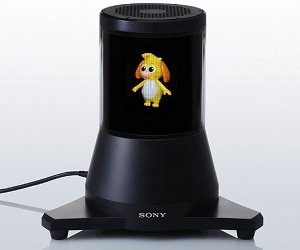
The display, which is due to be demonstrated at Japan's Digital Content Expo this Thursday, can be seen over at Impress (Babelfish translation), and it's certainly a departure from the norm.
Rather than a traditional flat screen, the 13 x 27cm cylinder looks more like a stylish desktop water cooler than a display. However, at the heart of the device is a wraparound OLED display that shows an image that can be viewed from any angle - in true 3D. This makes it very different from standard 3D displays that project a 3D picture via anaglyph images or polarising filters.
Sadly, the resolution is currently far from high definition standards: although the little figure is presented in glorious 24-bit colour, it's a mere 96x128 pixels in size (0.12 megapixels), so it's not exactly photo-realism.
That said, the device is clearly a prototype, and a smart one at that. Sony reckons the device will be handy for anyone who needs to work with three dimensional objects, such as those in the medical imaging market. What's more, it will also have the obvious "cool" factor that could see it being snapped up as a neat 3D photo frame - as long as someone releases a decent 3D camera, that is.
A video of the device is available on Sony Japan's website, although the true test of the gadget will of course be the public demonstration on Thursday.
Does Sony's latest wheeze looks like the 3D display you've always wanted, or does the technology have a long way to go before products such as this will be genuinely marketable? Share your thoughts over in the forums.
вторник, 13 октября 2009 г.
Japanese Students Create 3D Version of Destroyed Neighborhood
Hello to you
I was surfing the Net and found the article about very touching act. I think these guys deserve to be proud if.
Students at Japan's University of Nagasaki are attempting to recreate a neighborhood an atomic bomb destroyed. Seventy thousand people died when the United States dropped an atomic bomb on Nagasaki to end World War II. Pictures and memories of the Urakami neighborhood at the city's center vanished with them. But a 3D project is bringing the neighborhood back to life.
University of Nagasaki professor Byondok Jun's vision to recreate the city's Urakami neighborhood began with one image: an aerial photo of Nagasaki, taken by a U.S. warplane.
The image was snapped two days before the U.S. dropped an atomic bomb on the city near the end of World War II. But it was only released a few years ago. The black and white image captured a hospital, the university and surrounding homes; all buildings that were destroyed on August 10, 1945.
Jun says the image brought back the trees, the laughter, the city that existed before the attack. It gave him the first glimpse into life in Urakami and inspired him to recreate a three-dimensional image of the neighborhood.
Jun only planned to complete the aerial image - but students Yurika Uchijima and Kanouko Maeda asked to take the project a step further. They wanted to recreate street corners and store fronts - making the images more personal - for their graduate thesis.
Maeda says they had no idea where to start. They studied the professor's 3D aerial image first. Then they set out in search of old pictures of the Urakami neighborhood.
There was one problem: most photos of the community were destroyed in the attack. With few images to draw from, Maeda and Uchijima went in search of atomic bomb survivors and relied on their descriptions of Urakami.
Eighty-year-old Yoshitoshi Fukahori heard about the project and agreed to help out.
Fukahori says some question why I did this for free. But I felt an obligation to share my story as an atomic bomb survivor.
Fukahori was a teenager in 1945. He describes the Urakami neighborhood as one big family that opened its doors to everybody. He recalls the community gathering at the local barbershop to celebrate the smallest accomplishments and share in each other's joy.
In the early 1940s, Japan had conquered much of Asia and was at war with China, Britain and the United States. To end the war in August 1945, the United States dropped the first atomic weapons ever used on the cities of Hiroshima and Nagasaki. A few days later, Japan surrendered.
Fukahori was not home the day of the bombing but his sister was.
He says he found her dead a few days later. She was grasping the beam of their home. His uncle was crushed under the building and his aunt died as well.
Fukahori has spent the past 30 years collecting pictures of his old neighborhood for Nagasaki's Foundation for Peace.
Now those pictures are the foundation of a project to bring his memories back to life.
Student Yurika Uchijima says Fukahori pointed them to the playgrounds and a well where neighborhood children gathered to relax. She says he put a personal story behind every one of the buildings.
The students have used those stories and the few pictures available to recreate 3D images of more than a tenth of Urakami's building. They hope to complete the project by December. Uchijima and Maeda do not have any idea how their images will be used after that but professor Jun sees it as a tool for peace, one that teaches another generation about the power of a nuclear weapon.
I was surfing the Net and found the article about very touching act. I think these guys deserve to be proud if.
Students at Japan's University of Nagasaki are attempting to recreate a neighborhood an atomic bomb destroyed. Seventy thousand people died when the United States dropped an atomic bomb on Nagasaki to end World War II. Pictures and memories of the Urakami neighborhood at the city's center vanished with them. But a 3D project is bringing the neighborhood back to life.
University of Nagasaki professor Byondok Jun's vision to recreate the city's Urakami neighborhood began with one image: an aerial photo of Nagasaki, taken by a U.S. warplane.
The image was snapped two days before the U.S. dropped an atomic bomb on the city near the end of World War II. But it was only released a few years ago. The black and white image captured a hospital, the university and surrounding homes; all buildings that were destroyed on August 10, 1945.
Jun says the image brought back the trees, the laughter, the city that existed before the attack. It gave him the first glimpse into life in Urakami and inspired him to recreate a three-dimensional image of the neighborhood.
Jun only planned to complete the aerial image - but students Yurika Uchijima and Kanouko Maeda asked to take the project a step further. They wanted to recreate street corners and store fronts - making the images more personal - for their graduate thesis.
Maeda says they had no idea where to start. They studied the professor's 3D aerial image first. Then they set out in search of old pictures of the Urakami neighborhood.
There was one problem: most photos of the community were destroyed in the attack. With few images to draw from, Maeda and Uchijima went in search of atomic bomb survivors and relied on their descriptions of Urakami.
Eighty-year-old Yoshitoshi Fukahori heard about the project and agreed to help out.
Fukahori says some question why I did this for free. But I felt an obligation to share my story as an atomic bomb survivor.
Fukahori was a teenager in 1945. He describes the Urakami neighborhood as one big family that opened its doors to everybody. He recalls the community gathering at the local barbershop to celebrate the smallest accomplishments and share in each other's joy.
In the early 1940s, Japan had conquered much of Asia and was at war with China, Britain and the United States. To end the war in August 1945, the United States dropped the first atomic weapons ever used on the cities of Hiroshima and Nagasaki. A few days later, Japan surrendered.
Fukahori was not home the day of the bombing but his sister was.
He says he found her dead a few days later. She was grasping the beam of their home. His uncle was crushed under the building and his aunt died as well.
Fukahori has spent the past 30 years collecting pictures of his old neighborhood for Nagasaki's Foundation for Peace.
Now those pictures are the foundation of a project to bring his memories back to life.
Student Yurika Uchijima says Fukahori pointed them to the playgrounds and a well where neighborhood children gathered to relax. She says he put a personal story behind every one of the buildings.
The students have used those stories and the few pictures available to recreate 3D images of more than a tenth of Urakami's building. They hope to complete the project by December. Uchijima and Maeda do not have any idea how their images will be used after that but professor Jun sees it as a tool for peace, one that teaches another generation about the power of a nuclear weapon.
среда, 7 октября 2009 г.
Fujifilm Brings 3D Still Camera to the US
Hello! The new technique in US.
Fujifilm’s Real 3D W1 camera doesn’t throw the term “3D” around lightly. It actually creates three-dimensional still and video images, and prints them out on special paper. Here’s how it works: The camera has two sensors and two lenses, and Fujifilm’s Real Photo 3D processor combines them into a single image. On the back of the camera, a special monitor controls the direction of light sending different images into each eye, so you can preview the 3D stills without special glasses. Special paper basically mimics this concept, laying the image onto a “lenticular sheet” that creates a different angle of view for each eye.
In addition to the automatic 3D photography, the 3D W1 has a few advanced photo modes, allowing you to snap shots at different angles or at different time intervals, creating a greater illusion of depth. And while previewing the photos, you can actually control the parallax effect that separates foreground and background images.
Gimmicky? Sure, so it’s helpful that the 3D W1 also lets you shoot in tried-and-true 2D. The image sensor has 10 megapixels, and the lens zooms to 3x. Bundled software converts 3D images into 2D. There’s no exact word on availability asking price will be around $600.
Fujifilm’s Real 3D W1 camera doesn’t throw the term “3D” around lightly. It actually creates three-dimensional still and video images, and prints them out on special paper. Here’s how it works: The camera has two sensors and two lenses, and Fujifilm’s Real Photo 3D processor combines them into a single image. On the back of the camera, a special monitor controls the direction of light sending different images into each eye, so you can preview the 3D stills without special glasses. Special paper basically mimics this concept, laying the image onto a “lenticular sheet” that creates a different angle of view for each eye.
In addition to the automatic 3D photography, the 3D W1 has a few advanced photo modes, allowing you to snap shots at different angles or at different time intervals, creating a greater illusion of depth. And while previewing the photos, you can actually control the parallax effect that separates foreground and background images.
Gimmicky? Sure, so it’s helpful that the 3D W1 also lets you shoot in tried-and-true 2D. The image sensor has 10 megapixels, and the lens zooms to 3x. Bundled software converts 3D images into 2D. There’s no exact word on availability asking price will be around $600.
пятница, 14 августа 2009 г.
3D Photo Builder Bunch
3D Photo Builder Bunch is a new cost effective bunch helps to create and let your online customers view your 3D panoramas and 3D Images online. It includes universal A3D Photo Builder Pro, A3D Pano Viewer Pro and A3D Presentation Applet. This kit of comprehensive solutions increase productivity, improve processes and lower costs. Our new Bunch may be of strategic value for your online business site if you are interested in enriching it with interactive animations of real objects with the ability for the visitors to zoom, drag and rotate your products. It comprises A3D Photo Builder Pro and A3D Presentation Applet. Functional and interactive product models cut costs, reduce lead time, and improve the quality of product presentations. Give your customers true 3D experience!
вторник, 11 августа 2009 г.
Now you won’t find the border between neighbour shots!
Algorithms based on combination of modern technologies and long-time practical work allow to create perfect quality panoramas. Our Blending technologies are leading; it was confirmed by our clients many times. The quality of our 3D Panoramas corresponds to the most strict requirements of professional processing.
Universal set of pano types. Program generates two types of panoramas (Spherical (equirectangular) and Cylindrical types).
Fully automated stitching process. Stitching process is fully automated and doesn't require any special knowledge to proceed it.
Original alignment algorithm. Original alignment algorithm is not influenced by shots of poor quality or ones having distortions.
Autodetect of shooting conditions. Program is competitive with all rectilinear lens and Fish Eye lens. It automatically matches lens properties (Focal Length and Barrel Distortion), effectively compensates distortions having appeared while shooting (camera Tilt and Roll).
Automated hue saturation. We can help you avoid time and energy consuming process of brightness/contrast setting for separate shots and automatically compensate parameters difference for all shots.
Progressive "image warping" technology. Program uses progressive "image warping" technology, which directly changes images and combines conform elements. For transformations the program uses algorithms, which don't bring noise into the image and don't decrease its quality.
Universal set of pano types. Program generates two types of panoramas (Spherical (equirectangular) and Cylindrical types).
Fully automated stitching process. Stitching process is fully automated and doesn't require any special knowledge to proceed it.
Original alignment algorithm. Original alignment algorithm is not influenced by shots of poor quality or ones having distortions.
Autodetect of shooting conditions. Program is competitive with all rectilinear lens and Fish Eye lens. It automatically matches lens properties (Focal Length and Barrel Distortion), effectively compensates distortions having appeared while shooting (camera Tilt and Roll).
Automated hue saturation. We can help you avoid time and energy consuming process of brightness/contrast setting for separate shots and automatically compensate parameters difference for all shots.
Progressive "image warping" technology. Program uses progressive "image warping" technology, which directly changes images and combines conform elements. For transformations the program uses algorithms, which don't bring noise into the image and don't decrease its quality.
пятница, 7 августа 2009 г.
3D Photo Builder Pro
Here are the 3D Photo Builder Pro points:
* Rich set of processing tools.
o Advanced 3D Panorama stitching
o Professional 3D Image composing
o Built-in full-functional graphics editor
* Advanced intellectual algorithms set
o Unique stitching algorithm
o High quality blending algorithm
o Batch stitching mode
o Background online data exchange
o Support of full 360 and partial panoramas
o Autodetect of shooting conditions
o Chroma key background removal
* Convenient adjustable interface.
o Hierarchical Explorer-Style tree
o Drag-and-drop technology support
o Specialized clipboard
o Built-in Recycle Bin
o Progressive storage format.
o Complete and convenient help system
o Effective built-in viewing tools
o Built-In troubleshoot system
o Variety of 3D Object types
* Ready to WEB export results
o Built-in WEB page editor
o Web-browser preview
o High-speed 3D ImageViewer applet
o High-speed 3D PanoViewer applet
o Multiplatform optimized format
* Extended multiformat import-export system
o Extended import formats set
o Direct importing from a scanner or digital camera
o Direct importing from a TWAIN source
o Direct FTP publishing
o Direct EMail publishing
o Export to ZIP archive
o Export to A3D screensaver format
o Export to Flash, QTVR, AVI, EXE and much more!
o Publishing history support
* Rich set of processing tools.
o Advanced 3D Panorama stitching
o Professional 3D Image composing
o Built-in full-functional graphics editor
* Advanced intellectual algorithms set
o Unique stitching algorithm
o High quality blending algorithm
o Batch stitching mode
o Background online data exchange
o Support of full 360 and partial panoramas
o Autodetect of shooting conditions
o Chroma key background removal
* Convenient adjustable interface.
o Hierarchical Explorer-Style tree
o Drag-and-drop technology support
o Specialized clipboard
o Built-in Recycle Bin
o Progressive storage format.
o Complete and convenient help system
o Effective built-in viewing tools
o Built-In troubleshoot system
o Variety of 3D Object types
* Ready to WEB export results
o Built-in WEB page editor
o Web-browser preview
o High-speed 3D ImageViewer applet
o High-speed 3D PanoViewer applet
o Multiplatform optimized format
* Extended multiformat import-export system
o Extended import formats set
o Direct importing from a scanner or digital camera
o Direct importing from a TWAIN source
o Direct FTP publishing
o Direct EMail publishing
o Export to ZIP archive
o Export to A3D screensaver format
o Export to Flash, QTVR, AVI, EXE and much more!
o Publishing history support
четверг, 6 августа 2009 г.
Do you know?..
Have you ever thought that you can create 3d objects at home, not using the hard-in-use programms? You just have to have the camera and a programm which is very easy and intuitive in use.
Also you can create the 3d view of your room as interactive panorama.
Visit the Anything3D Corp. to learn more!
Also you can create the 3d view of your room as interactive panorama.
Visit the Anything3D Corp. to learn more!
Подписаться на:
Сообщения (Atom)